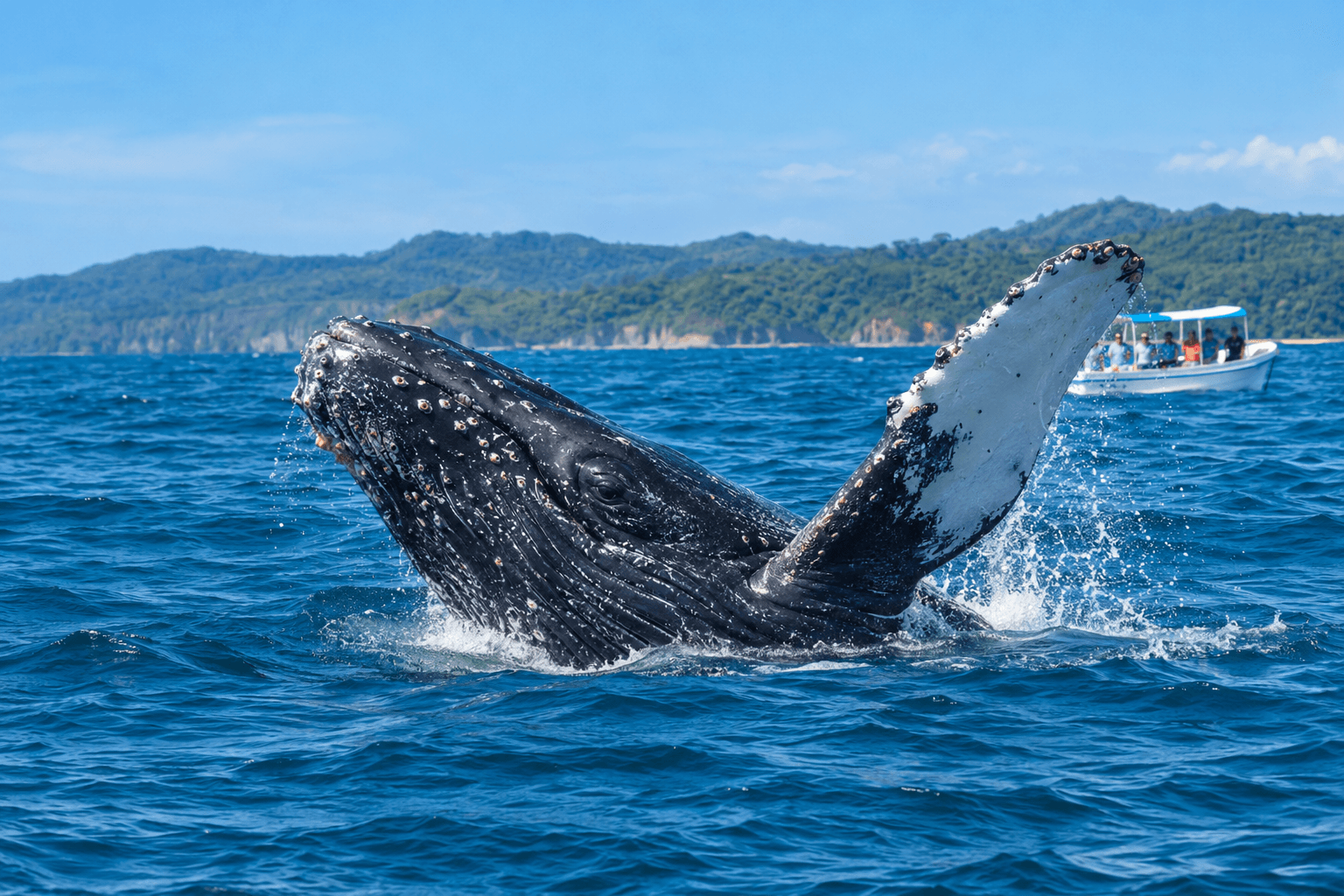
Why Do Humpback Whales Have Throat Pleats A Whale Anatomy Guide
Humpback whales are famous for their enormous size, long pectoral fins, and spectacular movements at the ocean's surface. Yet some of their most remarkable features are found in places that visitors rarely see clearly, including the underside of the throat.
Running along this area are deep folds of skin known as ventral throat pleats or ventral grooves. These expandable folds are not simply decorative features. They play an important role in the way humpback whales feed, allowing the mouth and throat region to expand as the whale takes in large quantities of water and prey.
For travelers preparing for a whale-watching excursion in Samaná Bay, Dominican Republic, understanding this feature offers a fascinating introduction to humpback whale anatomy. It also reveals how the structure of a whale's body reflects the demands of life in the ocean.
What Are Humpback Whale Throat Pleats?
Throat pleats are long, parallel folds of skin and underlying tissue that extend along the underside of a humpback whale, from the lower jaw area toward the belly.
When the whale is not feeding, these folds appear relatively close together. During certain feeding behaviors, the folds can spread apart, allowing the throat region to expand substantially.
This flexibility is especially important for humpback whales because they are baleen whales. Instead of using teeth to capture and chew their food, they take in prey-containing water and use baleen plates to filter out edible animals.
The pleats help accommodate the large volume of water taken into the mouth during this process.
Although the grooves may look like ordinary wrinkles in photographs, they are part of a specialized feeding system. Their shape, flexibility, and arrangement contribute to the whale's ability to exploit dense concentrations of prey.
Why Do Humpback Whales Need Expandable Throats?
Imagine trying to collect a large quantity of small fish or krill while moving through the ocean. A humpback whale needs to bring both prey and surrounding water into its mouth before separating the food from the water.
Its throat pleats allow the body region behind the mouth to expand during this process. Without this expandable structure, taking in large volumes of water would be much more difficult.
This adaptation is particularly useful during lunge feeding, a behavior in which a whale accelerates toward a concentrated patch of prey with its mouth open. Water and prey enter the mouth, and the expandable throat region accommodates the resulting volume.
The whale then uses its baleen plates to filter prey from the water.
The process requires coordination among the mouth, expandable tissues, muscles, and filtering structures. The throat pleats are therefore one component of a larger feeding system rather than a separate mechanism working on its own.
How Do Throat Pleats Work During Feeding?
Humpback whale feeding involves several connected stages. The exact movements vary with prey type and feeding strategy, but the general process helps explain why expandable throat folds are so important.
1. The whale approaches a prey concentration
Humpback whales feed primarily on small schooling fish and krill, depending on the region and food available. In their feeding grounds, they may locate dense patches of prey and position themselves to take advantage of them.
2. The whale opens its mouth
During a lunge, the whale opens its enormous mouth as it moves into the prey. Water and prey enter together.
3. The throat region expands
As water fills the mouth and expandable throat region, the ventral pleats spread apart. This expansion accommodates the volume of water being taken in.
4. The whale filters the water
After engulfing the prey-containing water, the whale closes its mouth and pushes water outward through its baleen plates. The baleen acts as a filtering system, retaining suitable prey while allowing most of the water to escape.
5. The whale swallows the prey
Once the water has been filtered out, the retained prey can be swallowed. The throat pleats then return toward their less-expanded state.
This sequence demonstrates how whale anatomy, movement, and feeding strategy work together.
Are Throat Pleats the Same as Baleen?
No. Throat pleats and baleen have different structures and functions.
Throat pleats are expandable folds of skin and underlying tissue on the underside of the whale. They help the throat and mouth region accommodate a large volume of water during feeding.
Baleen consists of plates made from keratin, the same broad type of structural protein found in human hair and fingernails. These plates hang from the upper jaw and form a filtering system.
Baleen allows a humpback whale to retain prey while water flows out through the plates. The throat pleats help accommodate the water and prey taken into the mouth in the first place.
Both are important adaptations, but they solve different parts of the feeding challenge.
Do All Whales Have Throat Pleats?
No. Throat pleats are particularly associated with rorqual whales, a group that includes humpback whales, blue whales, fin whales, and minke whales.
These whales have expandable throat grooves that support their specialized engulfment-feeding strategies.
Other whale groups have different feeding adaptations. For example, right whales also use baleen to filter small prey, but their feeding anatomy and typical feeding strategies differ from those of rorquals.
To understand a whale's anatomy, it is helpful to consider not just whether it has baleen, but also how its mouth, throat, body shape, and feeding movements work together.
Do Throat Pleats Help Humpback Whales Sing?
Throat pleats are best known for their role in feeding, not singing.
Humpback whale songs are complex vocal displays produced through specialized sound-producing structures and airflow-related mechanisms within the respiratory system. Researchers continue to investigate the detailed biomechanics of sound production in whales.
Although a whale's anatomy is interconnected, there is no good reason to treat throat pleats as the primary structures responsible for song production. Their established role is linked to expansion during feeding.
This distinction is a useful reminder that a single animal can possess different specialized structures for different biological tasks.
Can You See Throat Pleats During Whale Watching in Samaná?
Samaná Bay is associated with the seasonal presence of humpback whales during the Caribbean breeding season. Whale-watching visitors may see whales surfacing, lifting parts of their bodies above the water, or moving through the bay.
However, the underside of a whale is not always visible from a boat. Throat pleats are easier to study in scientific photographs, anatomical illustrations, and well-documented feeding footage than during many ordinary whale-watching encounters.
Humpback whales in their breeding grounds generally feed much less than they do in their colder-water feeding areas. Consequently, visitors should not expect to see a whale demonstrate lunge feeding or throat expansion during a typical Samaná excursion.
A whale-watching trip can still provide a valuable opportunity to learn about the species' anatomy and life cycle, even when particular feeding behaviors are not observed.
Why Are Humpback Whales Often Studied in Feeding Areas?
The role of throat pleats becomes especially clear when humpback whales are observed feeding.
In productive feeding areas, scientists can study how whales approach prey, open their mouths, engulf water, and filter food through their baleen. Photographs, video, and other research methods can help reveal how these movements relate to the whale's anatomy.
Researchers may also study feeding efficiency, energy use, and the relationship between whale behavior and prey distribution.
These observations help scientists understand how humpback whales obtain enough energy to support their large bodies, long migrations, and reproductive activities.
The contrast between feeding grounds and breeding grounds is important. Samaná is well known as a seasonal breeding destination, while feeding activity is generally more associated with colder, productive waters where suitable prey is abundant.
What Does This Adaptation Tell Us About Whale Evolution?
The throat pleats of humpback whales illustrate how an animal's anatomy can evolve in response to its feeding strategy.
For a large marine mammal that consumes small prey, taking in substantial quantities of prey-containing water can be an effective way to feed. Expandable throat tissues help make that strategy possible.
The adaptation is not useful in isolation. It operates alongside the whale's large mouth, baleen plates, muscular control, and ability to locate prey concentrations.
Together, these features allow humpback whales to feed efficiently in suitable environments.
Studying adaptations such as throat pleats also helps explain why different whale groups have different body structures. Their anatomy reflects the ways they obtain food and interact with their surroundings.
How Can You Learn More About Humpback Whale Anatomy Before Your Trip?
A little preparation can make a whale-watching experience more informative. Before visiting Samaná, consider reading about baleen, flippers, flukes, blowholes, and the differences between feeding and breeding behavior.
Scientific illustrations can be particularly useful for understanding features that are usually underwater or difficult to see from a boat.
During your excursion, listen to the guide's explanations and ask questions about the whale's visible anatomy. Remember that the crew may not be able to show every feature directly, and the animals should never be approached more closely just to improve visibility.
If you use photographs for educational content, ensure that the images accurately represent the anatomy being discussed. A picture of the whale's belly, for example, should not automatically be described as showing expanded throat pleats unless the folds are clearly visible.
Plan a Responsible Whale-Watching Excursion in Samaná
Learning about humpback whale anatomy can add depth to a trip to Samaná Bay. Instead of focusing exclusively on dramatic surface displays, visitors can appreciate the adaptations that allow these animals to survive and feed in the ocean.
Before booking an excursion, check the departure location, duration, inclusions, safety guidance, and wildlife-viewing practices. Ask the operator how it follows applicable local regulations and how it minimizes disturbance to whales.
Sightings and behaviors are never guaranteed. A responsible tour provider should not promise that visitors will see a feeding display or a clear view of a whale's throat pleats.
The goal is to experience these animals in their natural environment while respecting their space and behavior.
Final Thoughts
Humpback whale throat pleats are specialized expandable folds that play an important role in feeding. They allow the throat region to expand as a whale engulfs prey-containing water, helping support the lunge-feeding strategy used by these baleen whales.
Working together with the mouth and baleen plates, these folds form part of a remarkable feeding adaptation. Although throat pleats may not be easy to observe during a whale-watching trip in Samaná, learning about them helps visitors understand the biology behind the whales they encounter.
Planning to see humpback whales in Samaná Bay? Explore available local whale-watching excursions, confirm current tour details with the operator, and choose a responsible experience that puts wildlife welfare first.
*Editori

Local explorer & expert guide in Saona Island Beach.