How Do Scientists Identify Humpback Whale Mother-and-Calf Pairs in Samaná Bay?
Every year, humpback whales visit the waters around Samaná in the Dominican Republic during their seasonal breeding period. Among the animals that visitors may encounter are adult whales swimming close to smaller calves.
These pairs attract scientific interest because their behavior can provide clues about early development, maternal care, and the use of breeding habitat. However, researchers cannot confirm a mother-and-calf relationship simply because two whales swim near each other. They need to assess several observations and document how confident they are in their conclusions.
So, how do scientists identify possible humpback whale mother-and-calf pairs in Samaná Bay They combine differences in body size, swimming behavior, repeated observations, photographs, and other available evidence.
Why Are Mother-and-Calf Pairs Important to Study?
Breeding and nursery areas are important parts of the humpback whale life cycle. Calves must develop swimming abilities, coordinate their movements with an adult, and build the strength needed for migration.
Studying mother-and-calf pairs can help researchers investigate questions such as:
- How do calves behave at the surface?
- How closely do calves remain alongside adult whales?
- How do adult whales and calves coordinate their movements?
- Do calves show different surfacing patterns from adults?
- Which areas are repeatedly used by observed pairs?
These questions can contribute to understanding whale behavior and the importance of seasonal habitat. They do not, by themselves, establish how many calves use Samaná Bay or whether local calf numbers are increasing or decreasing.
1. Comparing the Body Sizes of Two Whales
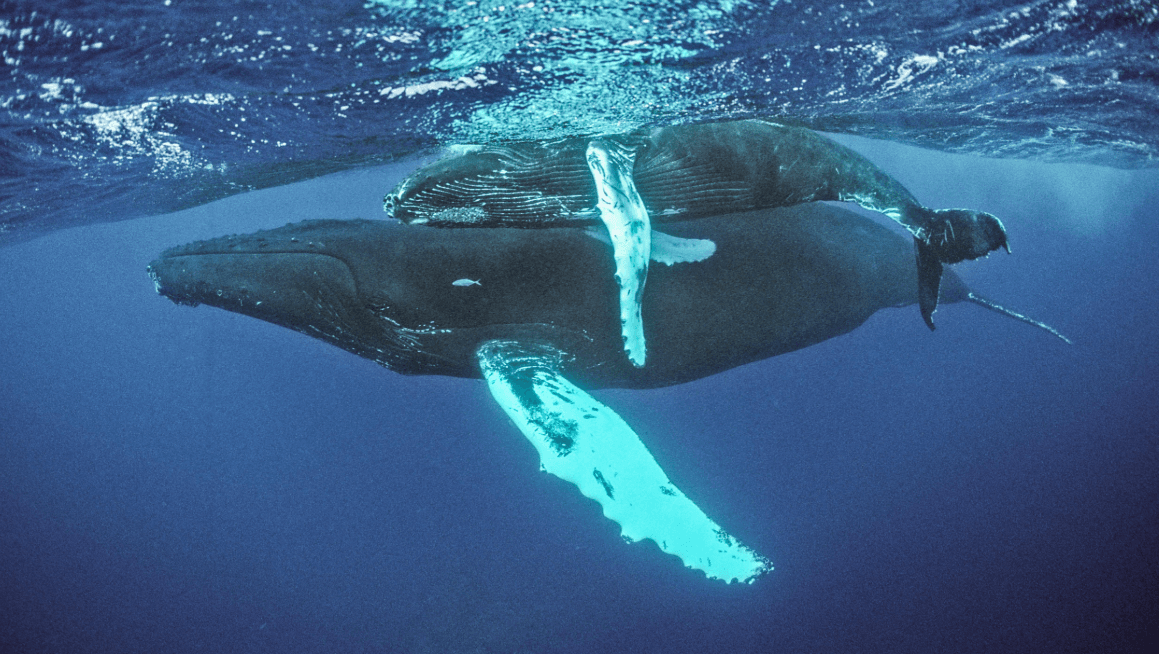
One of the first clues is the apparent size difference between an adult whale and a smaller whale swimming nearby.
Adult humpback whales can reach approximately 12–16 meters in length, although sizes vary. Calves are substantially smaller, especially early in life. Researchers observing a possible pair may therefore look for a large whale accompanied by a noticeably smaller animal.
However, size estimates made from a moving boat can be unreliable. Distance, viewing angle, waves, and the amount of each whale visible above the surface can distort apparent proportions.
For this reason, size difference is best treated as an initial clue rather than definitive proof of a mother-and-calf relationship.
2. Observing How the Whales Swim Together
Researchers also examine the pair's relative positions and movements.
A calf may swim close to an adult, surface nearby, or adjust its direction as the adult changes course. These observations can help scientists determine whether the animals are behaving as a coordinated pair.
Researchers may record:
- The distance between the two whales.
- Whether they travel in the same direction.
- Whether their surfacing events occur close together.
- Whether the smaller whale repeatedly follows the adult.
- Whether the pair remains associated over multiple observations.
No single behavior confirms parentage. Two whales may swim together for reasons unrelated to a mother-and-calf relationship, so scientists interpret behavior alongside other evidence.
3. Recording Surfacing and Diving Patterns
Humpback whales regularly surface to breathe, and researchers can observe how a possible pair behaves during these events.
For example, a smaller whale may surface close to an adult before both animals dive again. A field observer can record the timing and spacing of these events, including whether the association continues over several surfacing cycles.
Such records are useful for describing behavior, but scientists should avoid assuming that every coordinated dive or simultaneous surfacing indicates a maternal relationship.
Observation records become more informative when they include consistent timestamps, descriptions of the animals, environmental conditions, and the duration of the encounter.
4. Using Photographs and Video Records
Photographs and video allow researchers to review an encounter after leaving the water.
Images may help document differences in body size, relative position, visible markings, and other identifying features. Video can also reveal the sequence of movements that might be difficult to capture in a brief sighting.
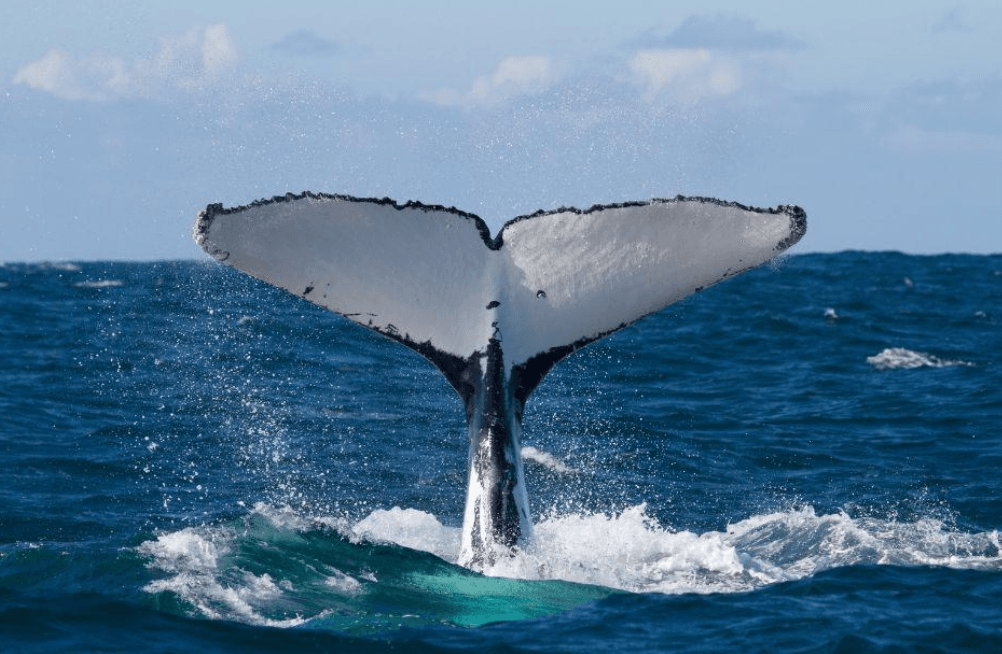
If the adult's tail fluke or other distinctive features are photographed clearly, researchers may compare the images with existing identification records. Identifying an adult can help connect an encounter with previous sightings, although it does not automatically establish the identity or parentage of the accompanying calf.
Good documentation includes the date, time, approximate location, image quality, and the circumstances of the observation.
5. Following the Pair Across Multiple Observations
Repeated observations can strengthen the evidence that two whales are associated.
If the same adult and smaller whale remain together throughout an encounter, observers can document the persistence of their association. If a recognizable adult is photographed again with a calf later, researchers may compare the records to investigate whether the same individuals were involved.
Nevertheless, repeat sightings need careful interpretation. A whale seen with a calf on separate occasions does not necessarily prove that every accompanying smaller whale is its offspring. Individual identification, reliable records, and appropriate research methods are needed to make stronger claims.
Researchers should also avoid counting repeated encounters with the same pair as separate mother-and-calf pairs when estimating the number of individuals observed.
6. Distinguishing a Likely Pair From a Confirmed Relationship
Field researchers often work with incomplete information. A whale may remain underwater for long periods, photographs may be unclear, and an encounter may last only a few minutes.
Scientists can therefore classify observations according to the strength of the available evidence. For example, an adult and a smaller whale swimming closely together might be recorded as a possible mother-and-calf pair. More extensive, consistent evidence may justify a stronger classification under the study's criteria.
Direct genetic evidence can establish biological relationships more definitively, where suitable samples can be obtained and analyzed under appropriate research and ethical protocols. Such testing is not necessary or available for every field observation.
The important distinction is between recording a likely relationship and claiming that parentage has been conclusively established.
7. Why Samaná Bay Is Relevant to This Research
Samaná Bay is internationally known for seasonal humpback whale activity, particularly during the breeding season in the waters of the Dominican Republic. Observations of adults and calves can provide opportunities to study their behavior in a breeding-area setting.
Researchers can document possible pairs, describe their behavior, and investigate how observed animals use the area. Long-term, carefully managed records may also contribute to broader studies of reproduction and habitat use.
However, the presence of a pair during a whale-watching trip should not be interpreted as evidence of a particular population trend. Claims about calf numbers, reproductive success, or year-to-year changes require suitable data collected and analyzed over time.
8. How Responsible Whale Watching Supports Observation
Whale-watching trips can introduce visitors to humpback whales, but the welfare of the animals must remain a priority.
Boats should follow applicable local regulations and responsible wildlife-viewing guidance. Operators should avoid chasing whales, crowding them, or making sudden approaches that could disrupt their behavior.
This is especially important when a small whale is traveling alongside an adult. Observers should not assume that close proximity to a boat is harmless simply because the animals remain visible.
Visitors can support responsible observation by choosing operators who follow local rules, respect wildlife distances, and avoid pressuring whales for closer photographs.
Frequently Asked Questions
How can scientists tell whether a small whale is a calf?
Researchers consider its apparent size, physical development, behavior, and association with an adult. Visual estimates alone may be uncertain, so observations should be documented carefully.
Does a calf always swim directly beside its mother?
Not necessarily. The distance and relative position between an adult and calf can change as they swim, surface, and dive. A single observation cannot establish a universal pattern.
Can photographs prove that two whales are mother and calf?
Photographs can document an association and may help identify individual whales. Ordinary photographs alone generally cannot prove a biological relationship.
Why do researchers record the same pair more than once?
Repeated observations can help researchers document how long the animals remain associated and compare their behavior across encounters. Researchers must account for repeat sightings when estimating the number of distinct pairs.
Can visitors see humpback whale calves in Samaná Bay?
Calves may be observed during the seasonal period when humpback whales use the region, but sightings depend on whale movements, sea conditions, and other factors. Seeing a calf is never guaranteed.
Conclusion
Identifying humpback whale mother-and-calf pairs in Samaná Bay involves more than spotting a large whale beside a smaller one. Scientists examine relative body size, coordinated swimming, surfacing behavior, photographs, and repeated observations to assess whether the animals are likely to be a pair.
Careful recordkeeping and honest reporting of uncertainty help prevent mistaken identifications. These methods can improve knowledge of humpback whale behavior and breeding-area use while supporting responsible wildlife observation in the Dominican Republic.

Local explorer & expert guide in Saona Island Beach.